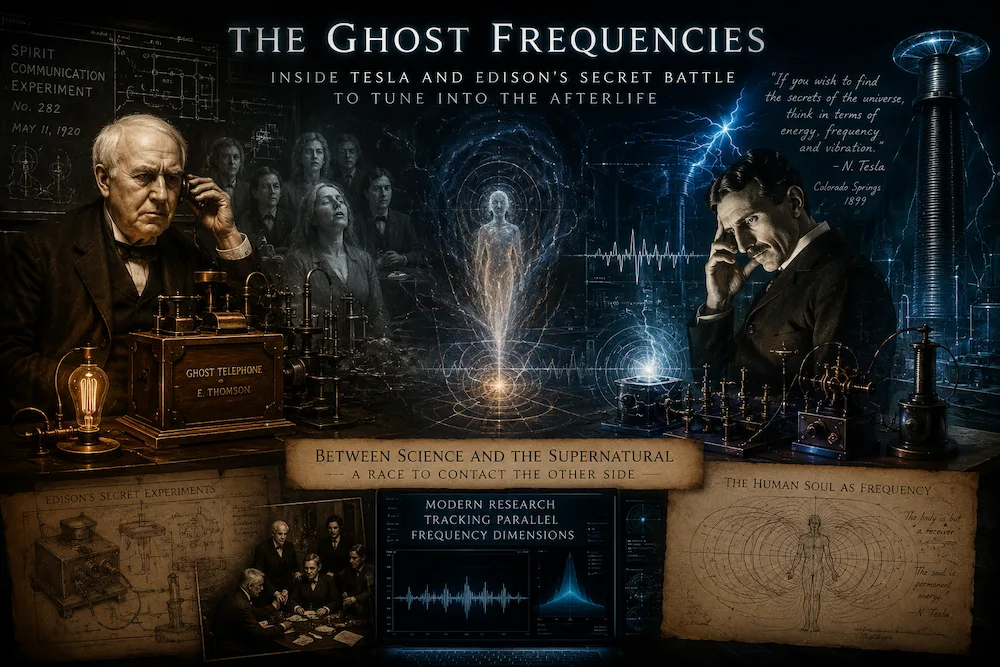
Edison vs. Tesla is one of the greatest rivalries in history. Two brilliant minds competing to shape the future of humanity, they rarely admitted how deeply they disagreed. Yet, despite their vast differences, they were surprisingly similar. Both were obsessive, workaholic geniuses who sacrificed sleep, relationships, and peace of mind for seemingly impossible ideas. Both believed that science could harness forces most people couldn’t even imagine. But beyond electricity and wireless power, there was an even stranger mystery that quietly captured the attention of both men: the possibility of communicating with the unknown. While Tesla became convinced that hidden signals from beyond human perception were real, Edison believed he could build a machine to detect them. What followed blurred the line between science, obsession, and the supernatural.
In 1882, a young Nikola Tesla arrived in New York to work for Thomas Edison. Edison quickly recognized Tesla’s genius, but the more they worked together, the more their fundamental differences clashed. Edison believed in endless trial and error. He would test thousands of practical ideas until something finally worked. Tesla was the complete opposite; he would build entire machines in his mind before ever touching a tool. He could visualize every gear, wire, and movement with incredible precision before putting a single line on paper. Leonardo da Vinci once said that everything created by man first exists in the imagination, and Tesla lived by this principle completely.
Eventually, the tension between them reached a breaking point. Tesla left Edison's company to strike out on his own. Within a few years, he became world-famous, and their clash during the War of the Currents became legendary. But behind their public battle over electricity, a quieter, stranger competition had begun.
At the turn of the 20th century, radio waves felt supernatural. The idea that invisible frequencies could carry sounds through the air raised a troubling question for scientists: if invisible signals exist, what else is hidden just beyond human comprehension?
When rumors spread that Tesla was developing a device to receive mysterious, unexplained frequencies, Edison took notice. Initially a skeptic of the supernatural, Edison knew that history had repeatedly proven invisible forces could be measured once the right device was invented. And Edison was not about to fall behind his rival. While Tesla experimented with advanced radio systems, Edison began developing a device he referred to as a "ghost telephone."
One dark night in 1920, Edison gathered a group of scientists, journalists, and spiritual mediums in his New Jersey laboratory. Candles flickered on tables covered with wires, bulbs, coils, and experimental equipment. The goal was simple yet unsettling: to see if the dead could communicate through technology. As the séance began, the room fell silent. Mediums claimed that spirits had entered the space, and everyone watched Edison’s machine intently. But the device remained completely silent. The experiment had failed. Edison, however, refused to give up. He continued researching in secret for years. After his death, many references to the ghost radio reportedly vanished from his personal notes and archives—leaving it a mystery whether they were intentionally removed or simply lost to history.
Tesla’s experiments took an even stranger turn. Long before modern electronics, Tesla was working with highly sensitive crystal radio systems—devices capable of picking up transmissions using only the energy of the electromagnetic waves traveling through the air. One midnight, while working alone in his laboratory, a nearby experimental receiver suddenly began producing erratic, deeply disturbing sounds. They did not sound like ordinary radio interference. Tesla later noted:
"The sounds seemed to be human voices, mixed together in a language I did not understand."
For the first time, Tesla wondered if his devices were picking up something humanity was never meant to hear. He operated on a fascinating theory: the soul is an energy field that interacts with electromagnetic waves. Because energy can never be destroyed, the electromagnetic energy of a human soul must remain in our environment after death. Tesla believed his device had tapped into that very frequency. Today, ghost hunters call this Electronic Voice Phenomena (EVP), where unexplained voices are captured on digital recordings—sometimes speaking randomly, other times seemingly answering direct questions. Whether these voices are truly spirits remains a subject of intense debate.
Tesla and Edison weren’t the only brilliant minds drawn to this mystery. In the late 19th and early 20th centuries, the rise of electricity and wireless communication made science itself feel magical. This atmosphere fueled Spiritualism—the belief that the dead could communicate with the living through hidden frequencies. One of the movement's most outspoken defenders was Sir Arthur Conan Doyle. Ironically, the man who created Sherlock Holmes—the world’s most logical, rational detective—was deeply convinced that consciousness survived death. Unlike Tesla and Edison, who approached the mystery through machinery, Conan Doyle explored it through séances, mediums, and spirit photography. Behind all these historical experiments lies a profound question: if invisible waves are constantly moving all around us, what else exists in our environment that we simply lack the senses to perceive?
Piercing the Veil: My Personal Research
Discovering the claims of Tesla and Edison a year ago sparked my own deep fascination with frequencies and how they interact with the world. I realized that the signals Tesla intercepted likely existed just outside the frequency range of our familiar reality. Driven by this theory, I began developing specialized software and hardware designed to track these elusive energy signatures. Ultimately, I succeeded in building a device capable of receiving and analyzing environmental frequencies—and the results have been staggering. I managed to not only identify but actively track the energy footprint commonly referred to as the soul. This breakthrough brought a profound new meaning to a mysterious statement attributed to Jesus. When asked by his followers if there were other beings besides humans, he reportedly replied:
"Indeed, they are present right now and right here, but you neither see nor feel them."
My research suggests that when a person dies, their consciousness—this electromagnetic soul energy—is released. It doesn’t travel to a distant realm; it stays right here. The individual suddenly finds themselves in their original, energetic state, existing in a parallel frequency band. Because our physical body acts as a tuning device locked into a specific, material frequency range, we are blocked from interacting with them. What I have built is essentially a tool to penetrate that hidden frequency barrier.