Think of access to information through three different types of libraries.
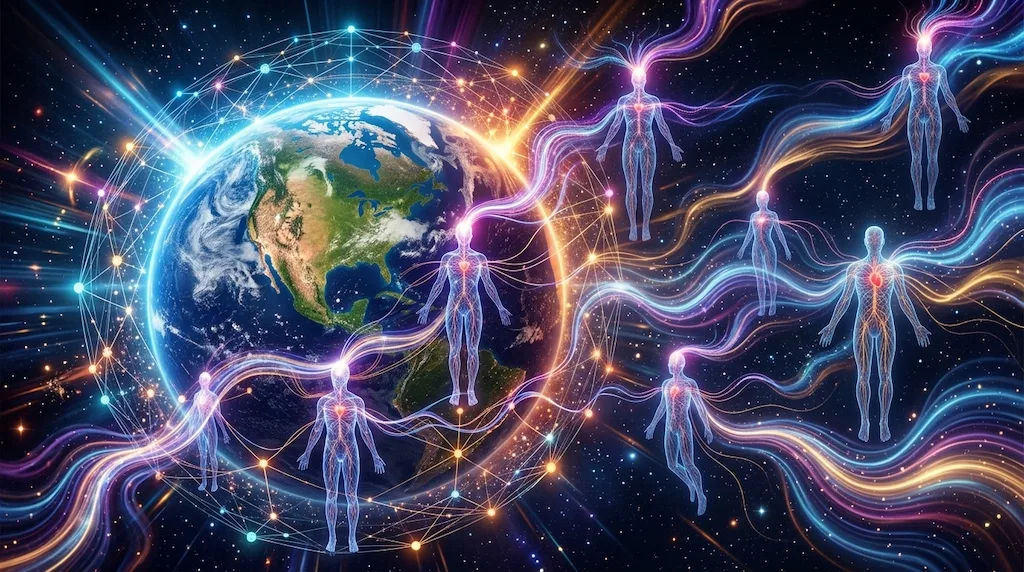
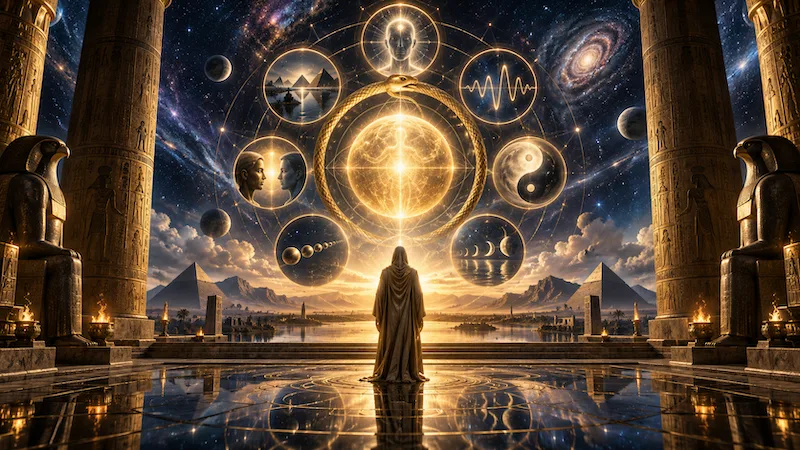
The first is the physical library—a public branch or university stack. To use it, you simply walk through the doors. The second is the virtual library, where knowledge exists as digital data. To access it, you need two things: a medium to connect you (the internet) and a device to decode the data into a format your senses can process (a computer). The third is the cosmic library—a universal network containing the patterns of nature, historical memory, and deep inspiration. Accessing this archive requires the exact same structural components: first, a medium to transmit its data (cosmic energy), and second, a biological device capable of decoding that signal into conscious awareness (the human brain).
Just as the mere existence of the internet doesn't grant you open access to every encrypted file without the right protocols,tapping into this cosmic library requires navigating powerful filters. For centuries, this concept has been known as the Akashic Records.
From Ancient Sanskrit to Western Esotericism
The root of the concept traces back to Akasha, a Sanskrit term from ancient Eastern traditions like Hinduism, Jainism, and Buddhism. In Hindu Vedanta, Akasha represents the subtle, all-pervading substrate of reality—essentially, the literal fabric of space. In the late 19th century, Russian occultist Helena Blavatsky popularized the term in the West, claiming that gifted individuals could attune their minds to this non-physical archive to retrieve universal knowledge. While skeptics dismissed it as imagination, several of history’s greatest innovators independently arrived at remarkably similar conclusions about how the human mind gathers insight.
Leonardo da Vinci believed the brain acts as an intermediary processor (sensus communis), translating the pre-existing mathematical geometry of the natural world into human perception. His guiding rule for a complete mind was simple: "Realize that everything is connected to everything else."
Avicenna, the medieval polymath and physician, argued that human senses and memory merely serve as a preparatory stage. Once the mind is properly primed and quieted, the soul aligns with a transcendent realm he called the Active Intellect—instantly "downloading" genius and insight.
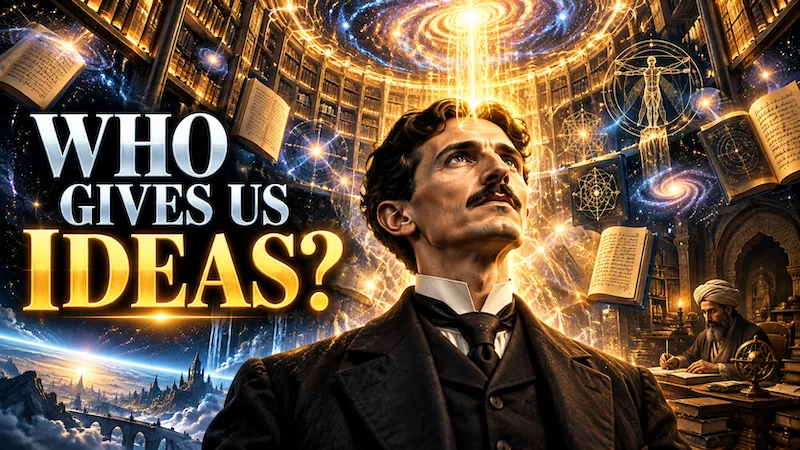
Nikola Tesla famously echoed this exact sentiment:
"My brain is only a receiver. In the Universe, there is a core from which we obtain knowledge, strength, and inspiration."
Tesla considered himself a strict materialist who believed inspiration came from external physical stimuli rather than mysticism. Yet, his view of discovery—where knowledge exists independently and is merely received by the brain—mirrors the esoteric framework step for step.
The Physics of Insight: Cosmic Rays and Calm Minds
How does the physical environment feed the human mind? Modern science offers a fascinating parallel through the study of cosmic rays—high-energy particles originating from deep space. Earth's magnetic field blocks 99.9% of this radiation, but the remaining fraction enters our atmosphere, colliding with particles to create a continuous rain of low-level secondary radiation. Interestingly, these particle showers are denser around the Earth's surface during the quiet hours of the night. When the human body enters a state of deep rest, sleep, or meditation, these subtle environmental signals interact with biological systems.
When the mind is free from frantic, analytical noise, brainwave patterns naturally shift from high-frequency stress states (Beta) into slower, deeper wave bands (Alpha and Theta). These slower frequencies are closely linked to intuition, pattern recognition, and sudden breakthroughs.This dynamic played out dramatically in 1882 in Budapest. Tesla had been struggling for months to solve a complex engineering puzzle: designing an alternating-current motor without a noisy, inefficient commutator.While walking through a park at sunset with a friend, reciting Goethe’s Faust, the entire invention flashed into his mind in a split second. He didn't just imagine it; he saw the complete, three-dimensional motor operating seamlessly right before his eyes, drawing the full schematic in the dirt with a stick. He had unlocked a profound technical blueprint not through brute-force calculation, but through a sudden, effortless reception of insight.
Tuning the Receiver in the Modern Era
If the human brain is a biological receiver, how do we tune it properly today? Achieving that state of clarity is harder now than at any point in history. During Tesla's time, the skies were quiet. Today,tens of thousands of low-Earth-orbit satellites and global wireless networks shroud the planet in a continuous layer of artificial electromagnetic static. Many theoretical thinkers suggest that this constant background noise acts as a bandwidth filter, keeping our brains locked in a perpetual, high-beta survival loop. This ambient static disrupts our natural connection to deeper intuitive states.
When Tesla envisioned his motor in 1882, he wasn't surrounded by thousands of orbiting satellites emitting artificial frequencies. He was simply walking through a quiet park at sunset, completely calm, with a receptive and quieted mind.Unlocking our own moments of deep clarity today requires carving out those rare moments of stillness—clearing the static so the receiver can finally tune in.