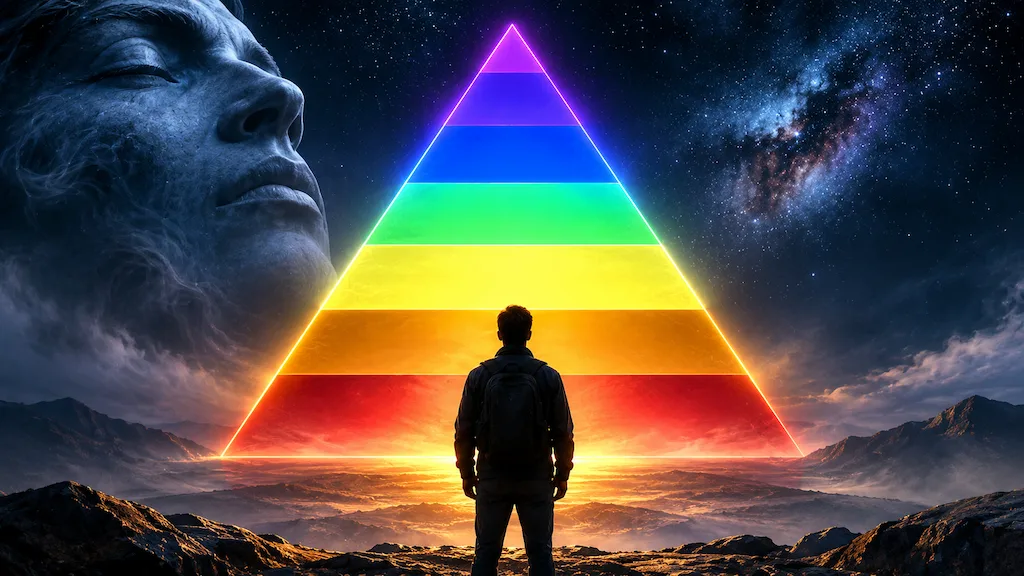
What happens when two people live in the same city, walk the same streets, and gaze at the same sky, yet experience two entirely different worlds? One sees only what lies directly before them. The other begins to perceive the invisible patterns hidden beneath everything. One accepts reality exactly as it is presented; the other cannot stop asking, "Why?"
Do all human beings experience reality from the same level of consciousness? Throughout history, philosophers, mystics,and spiritual traditions have described "awakening" as a journey from ignorance toward understanding—a journey consisting of seven distinct stages of human awareness. Yet most people spend their entire lives without ever consciously exploring these deeper stages. Today, we will traverse these seven levels together. Along the way, ask yourself one question: Where am I on this journey? By the end of this article, your perspective on your own life may never be quite the same.
Level One — The Asleep Mind
At Level One, you live within a system that you rarely, if ever, question. You work, consume, follow the rules, seek entertainment, and sleep. Tomorrow, you repeat the exact same routine. Weeks turn into months, and months into years, until you come to believe that life is fundamentally nothing more than this repetition. You follow a path laid out for you in advance: go to school, find a job, build a career, buy a home, and eventually retire.Yet somewhere along the way, you forget to ask a very simple question: Is this truly the meaning of life and the reason for my existence?
At this stage, your thoughts are heavily shaped by your environment—your family, culture, education, and the media you consume. There is nothing inherently wrong with this; we all begin life by learning from the people and institutions around us. The danger arises when we stop examining what we have learned—when we mistake familiarity for truth, or follow a routine simply because everyone else does.
Imagine a fish that spends its entire life inside an aquarium. It knows every corner of its small glass world, yet it has never seen the ocean. And because it has never seen the ocean, it is not even aware of what it is missing. This is Level One. It is neither stupidity nor weakness; it is simply a state of awareness that has never been challenged.
Level Two — The First Crack
Here, things begin to shift. At first, you cannot quite explain why. You still go to work, participate in daily life, smile at others, and fulfill the expectations placed upon you. Yet deep down, something feels different. Routines that once brought comfort now feel strangely hollow. Conversations you used to enjoy no longer satisfy you. You look at the news—at the constant bickering, the endless rivalries, and the relentless pressure to achieve more, buy more, and simply be more—and gradually begin to ask yourself: Why does everyone seem to be racing toward something they can never truly attain?
Perhaps you have a good job, a comfortable home, and close friends—everything society claims should make you happy.Still, you feel that something essential is missing. This is the first crack in your familiar understanding of reality. It is an unsettling phase because you do not yet know what you are searching for; you only know that the answers you once accepted are no longer enough. Some interpret this in spiritual terms, while others view it as an existential crisis or a shift in values. Whatever you call it, one thing becomes clear: you have begun asking questions that your old way of life cannot answer. And once those questions emerge, they are impossible to ignore.
Level Three — The Questioner
At the third level, curiosity can no longer be suppressed. You begin to interrogate beliefs you once accepted without a second thought: Why do I believe what I believe? Where do my opinions actually come from? How much of my identity is truly my own?
You challenge political narratives and examine religious doctrines. You delve into philosophy, psychology, history, and science—not to memorize facts, but to uncover the genuine reasons behind how the world works. Gradually, you realize that believing in something is not the same as knowing it. That realization alone changes everything. However, there is a trap at this stage. When people first begin questioning conventional narratives, they sometimes assume that anything hidden must be the truth, while anything official must be false. True wisdom begins where Socrates found it: in recognizing the limitations of your own knowledge and accepting how many questions still remain. Those around you may not understand your shifting interests. They might tell you that you overthink things, that life isn't as complex as you make it out to be, and that you should just relax. But for you, questioning has become essential—driven by an inner urge to grasp reality beyond mere appearances.
Level Four — Seeing the Matrix
At the fourth level, you begin to discern the external systems that shape your perception. Consider the world you experience every day: how much of it stems from your own direct experience, and how much of it comes from a screen? A news headline. An advertisement. A social media algorithm. A political speech. An opinion repeated thousands of times until it begins to sound like an objective fact.
Modern society is built around powerful systems of information, economics, technology, and social influence. These systems do not require a secret mastermind behind them; they operate naturally through incentives, habits, competition,and human psychology. Social media platforms compete for your attention. Advertisers work to steer your decisions.Sensationalist headlines exploit the mind's evolutionary sensitivity to threats, while recommendation algorithms repeatedly feed you ideas that reinforce what you already believe. Gradually, the information surrounding you defines the boundaries of your perceived reality. This is another layer of "the Matrix"—not a computer simulation, but an invisible web of assumptions, incentives, and influences that quietly dictates how you think.
Ask yourself: if your attention is constantly occupied by outrage, entertainment, conflict, and an endless stream of notifications, how much room is left for independent thought? How often do you sit in silence—without a phone, music,or distractions—and simply observe your own mind? Recognizing the Matrix does not mean believing everything is a conspiracy; it means becoming aware of how easily human perception can be engineered.
Level Five — The Journey Inward
At the fifth level, something unexpected happens: you stop looking solely at the outside world. Up to this point, most of your attention has been directed outward—toward society, institutions, technology, and other people. You have been trying to understand everything that impacts your life from the outside in. Suddenly, a different question arises: What if the greatest obstacle to my freedom lies not outside me, but within myself?
You begin to examine your fears, insecurities, emotional triggers, habits, and reliance on the approval of others. You notice how your mind cycles through repetitive loops—how a painful memory can hijack your mood, how an imagined future can trigger anxiety in the present, and how your interpretation of an event dictates your experience of it. You arrive at a profound realization: while you cannot always control what happens around you, you can cultivate awareness over how you choose to respond. This does not mean that external events are merely products of your thoughts.The outside world is real, and circumstances matter—yet your inner world heavily shapes how you experience that reality.Two people can face the exact same hardship and respond in opposite ways: one is paralyzed by fear, while the other treats it as a catalyst for growth.
At this juncture, your relationship with awareness fundamentally shifts. Instead of asking, "Why is the world doing this to me?" you begin asking, "What truth about myself is this experience revealing?"
Level Six — The Frequency of Your Mind
In spiritual traditions, the sixth level is often described using terms like energy, vibration, and frequency. While physics uses vibration and frequency to describe measurable physical phenomena, spiritual discourse uses them metaphorically to capture our emotional and psychological states. Think back to the last time you felt deep fear. Your breathing became shallow, your muscles tensed, and your focus narrowed—the entire world suddenly looked hostile. Now recall a moment when you felt deep calm, gratitude, or genuine inspiration. Your body relaxed, your thoughts became clearer, and your perspective expanded.
The external world did not change between those two moments, yet your internal state transformed—and that state directly influences your choices, behavior, relationships, and ability to recognize opportunities. At this level, you cultivate a conscious relationship with your own mind through reflection, emotional regulation, mindful attention, and intentional action. You realize you do not have to chase every thought that crosses your mind. Whether you call this mastering your vibration or developing psychological flexibility, the result is the same: you understand how intention shapes reality. What you focus on consistently shapes your tomorrow. What you believe influences what you strive for, and what you practice transforms what you are capable of.
Level Seven — The Observer
Finally, we arrive at Level Seven—perhaps the most mysterious stage of all, because here the central question shifts one last time. You are no longer asking merely how society functions, how to improve your circumstances, or how to manage your thoughts. Instead, you ask something far more fundamental: Who is it that is experiencing all of this?
Consider your own life. Your body has changed completely since childhood. Your opinions have shifted, your memories have accumulated, and your beliefs, desires, and fears have continually evolved. The person you were ten years ago is not the exact same person reading these words today. Yet amidst all that change, the underlying experience of being awarehas remained constant. You can observe your thoughts, notice your emotions, recall your past, and imagine your future.
But who—or what—is doing the observing?
For thousands of years, this question has captivated philosophers and contemplative traditions alike. Some refer to this deepest layer of awareness as "the witness," while others speak of "pure consciousness." Meanwhile, neuroscience continues to investigate how subjective inner experience emerges from physical brain activity. Even today, there is no universally agreed-upon answer regarding the ultimate nature of consciousness. The significance of Level Seven lies in realizing that you exist beyond any single thought, emotion, social role, or belief. You no longer need to build your identity around "being right." You grow comfortable with uncertainty, develop genuine compassion for those who see the world differently, and rely far less on external validation to feel that your life has meaning. Here lies a quiet paradox: at the beginning of this journey, you may have wanted to escape the world. By the end, you discover that freedom does not require fleeing from anything—it begins with seeing your own experience clearly. You no longer wait for permission from others to think, question, or live consciously, because the responsibility for your awareness has always rested with you. And perhaps, that is the true meaning of awakening.