To connect a companion in the seventh century to a laboratory in Baghdad in the eighth, one must follow a single line of absolute trust—a three-step chain passed down from Salman the Persian to Jafar al-Sadiq, and finally to his ultimate disciple: Jabir ibn Hayyan. This lineage is how the cosmic architecture of the ancient world survived. It is a framework built upon four foundational pillars:
The Book of the Above
The Book of the Below
The Secret Book of Creation
The true identity of the Mind behind the Tablet
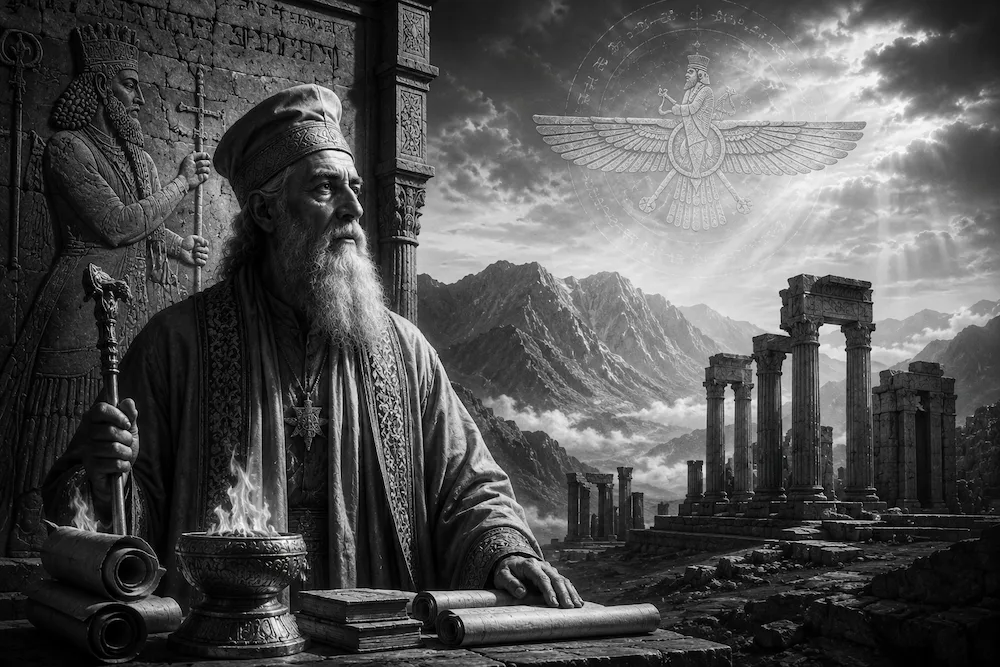
To understand how this transmission works, we must look at the title Salman’s contemporaries gave him. The physical origin of this cosmic architecture begins with Salman al-Farsi (Salman the Persian), one of the most enigmatic figures in esotericism. Salman was known as Abu al-Katabin (The Father of the Two Books) and as Luqman al-Hakim ( The Wise One).
In Arabic, the title Abu (father) does not merely denote ownership; it signifies a father of procreation—one who gives life, begets, and brings reality into being. Salman was no passive student of revelation. He was a living, historical bridge who devoted his life to the study of Mithraic astronomy, Zoroastrian elemental physics, and mystical cosmology.
Salman compiled the metaphysical frameworks of reality's two fundamental dimensions into two texts: The Book of the Above and The Book of the Below. By introducing these sciences to the inner circle of the Prophet Muhammad’s household, Salman "gave birth" to a unified alchemical worldview. He became the ultimate living bridge between the ancient Zoroastrian fire temples and the dawn of Islam. To understand how reality was written, we must examine these two master volumes:
1. The Book of the Above (The Realm of the Unseen)
The first book is written in the language of al-Batin—the hidden, internal, and spiritual reality. Although its text is addressed directly to the heavens, the stars, and the planets, the "above" refers to the underlying forces animating them. This book is a dynamic operating system of pure information consisting of three core components:
The Primordial Letters and Numbers: The vibrational frequencies generated to express the architecture of the universe.
The Celestial Engine: The spiritual blueprints of the seven planetary spheres and the twelve signs of the zodiac. These are not dead rocks in space; they are active gears channeling energy downward to shape our physical realm.
The Law of Descent: The process by which pure light descends and condenses through denser layers of reality until it manifests physically.
2. The Book of the below (The Realm of the Manifest)
The second book, the Book of the Below, is written in the language of al-Zahir—the external, visible, and physical world. This canvas is heavy matter governed by two foundational principles:
The Four Elements: The fundamental building blocks of all physical matter—heat, cold, moisture, and dryness.
Sulfur and Mercury: The mineral matrix stating that all metals are born from active, fiery vapors (sulfur) and passive, liquid properties (mercury) simmering deep within the Earth's womb.
These two books are perfect inverted mirrors of each other, reflecting the ultimate law of the universe: What is hidden above (within) is revealed below (without).
This also explains why physical properties invert spiritually:
Lead is physically cold and dry on the outside (the Book of the Below), but spiritually warm and moist on the inside (the Book of the Above).
Gold is physically warm and moist on the outside, but spiritually cold and dry on the inside.
By knowing what was contained within the book of the above, an alchemist could decipher how to manipulate the raw materials of the physical world.
While these two books formed a vast cosmic library, they lacked a practical interface. They required a translator to bridge the spiritual mathematics of the heavens with the boiling cauldrons of the laboratory.
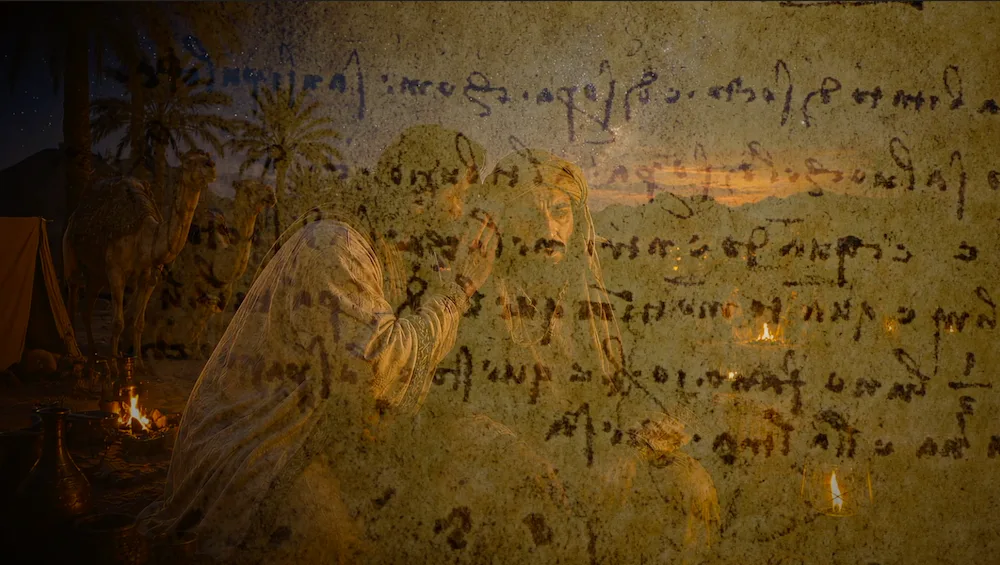
This is where Jabir ibn Hayyan comes in. To build this bridge, Jabir authored a book: Sirr al-Khaliqah (The Book of the Secret of Creation). In this text, Jabir fused celestial laws with physical elemental compositions. To make this bridge practical, he embedded a thirteen-line cryptographic key: The Emerald Tablet.
When viewed through Jabir's eyes, we see how he used Salman’s two books to construct his alchemy:
First The Mirror Principle:
"Which is Above is like that which is Below, and that which is Below is like that which is Above..."
Jabir used this to prove that every chemical reaction in his laboratory was a miniature reflection of a cosmic event.
The Dual Parents of Matter:
"Its father is the Sun [Sulfur] and its mother is the Moon [Mercury]."
This provided Jabir with the physical prescription for altering the elemental ratios of metals.
The Work of Separation:
"Separate the earth from the fire, the subtle from the gross..."
This was Jabir’s laboratory instruction. By purifying heavy, polluted matter below, he prepared it to receive the complete mathematical influence from above.
And this principle extends far beyond laboratory matter—for you yourself are a living instance of physical matter. In physical reality (the Book of the below), Zoroaster lived centuries before Jesus in Persia, and Jesus lived in Judea. They are two distinct historical human beings.
Yet in the spiritual realm (Book of the Above):
Zoroaster aligns with Khvarenah (the divine spark or glorious light) and the promised Saoshyant (the savior born of light).
Jesus aligns with the Logos (the light of the world).
When Zoroaster proclaims, "I and he are one; he is in me and I in him," and Jesus states, "I am in my Father, and you are in me, and I in you," they are executing the exact same code. They are acknowledging that when a human being purifies their heavy physical nature (clearing the impurities of lead in the Book of the Below), they become a polished mirror. When a mirror is perfectly polished, it no longer reflects itself; it reflects the light above. They are not claiming to be the same physical man they are claiming to be the same light descended into the material world.
The Historical Evidence
Modern historical analysis points to a striking conclusion: Jabir ibn Hayyan is the creator of the Emerald Tablet.
There is no surviving original or older copy of the Emerald Tablet in Greek, Syriac, or ancient Egyptian. Its earliest historical appearance is in Arabic texts produced in Baghdad during the 8th century. The name of the Emerald Tablet enters documented human history precisely at this time. Furthermore, the tablet employs specific Arabic chemical terminology—such as subtle for the inward and gross for the outward—terms that Jabir himself coined.
Attributing this tablet to the legendary Hermes Trismegistus was a brilliant act of preservation. If Jabir had claimed to invent a mathematical formula capable of rewriting physical matter, he would have been executed for heresy or for preserving ancient sciences targeted for destruction. By framing the text as an ancient discovery, he protected his life while granting the science the unquestioned authority of antiquity.
The Emerald Tablet is no magical talisman; it is a universal code. Salman the Persian laid down its structural components—the cosmic blueprint (the Book of the Above) and the physical canvas (the book of the Below). Jabir ibn Hayyan bound these dimensions together in The Secret of Creation, translating celestial mathematics into earthly elements.
To formalize this, Jabir wrote his masterwork, Kitab al-Mizan (The Book of Balance). He argued that every physical substance contains a precise mathematical ratio of elemental forces (heat, cold, dryness, and moisture). By applying the Science of Balance, an alchemist could measure the hidden inner nature (al-batin) against the external physical structure (al-zahir). The Emerald Tablet serves as the ultimate shorthand code for this principle: a formula designed to harmonize the lower physical world with divine proportions above. Whether discovered in a hidden cave or crafted in an 8th-century laboratory in Baghdad, the tablet remains the most sophisticated code ever written for the union of spirit and matter.