Memory has a lasting sense. We trust it more than any document, archive, or official reference. It feels personal, permanent, and reliable. But what happens when millions of people remember the same thing, and it never actually happened? To understand this, we need to go back to the 1980s and revisit a story that many people believe they remember vividly.
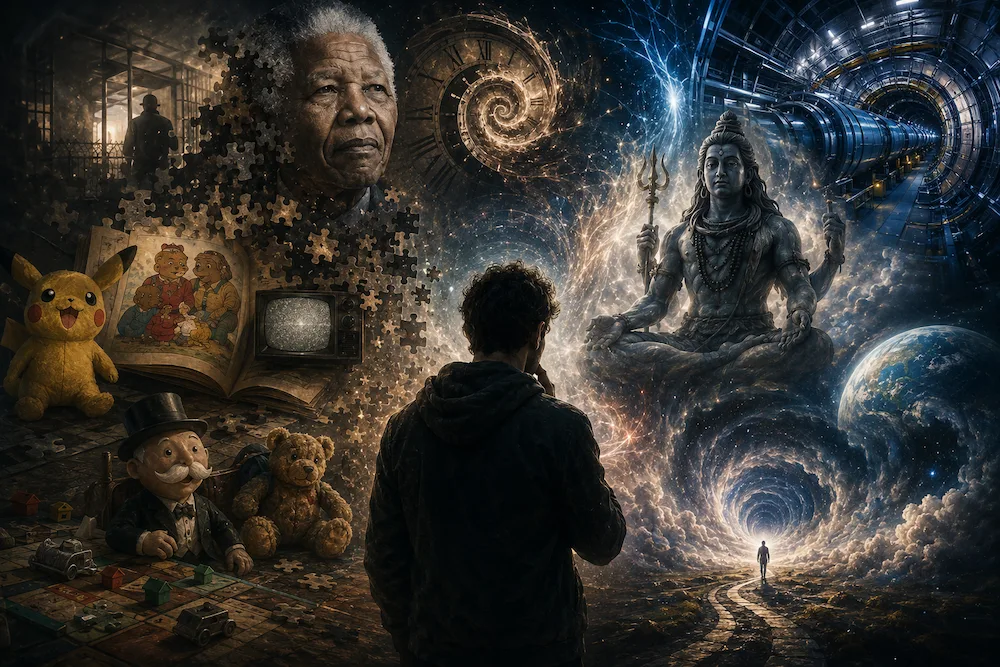
Nelson Mandela died in prison in 1980. At least, that’s how millions of people remember it. In reality, documented history tells a very different story. Nelson Mandela was released from prison in 1990, became president of South Africa in 1994, and passed away peacefully in 2013. These events are well recorded and undisputed. So why do so many people remember something that never occurred?
This phenomenon has a name: the Mandela Effect. It refers to cases where large groups of people share memories that conflict with recorded reality. And Mandela is far from the only example. If you grew up in the 1990s, you may remember the Pokémon character Pikachu with a black tip on his tail. Many people are absolutely certain of this detail. Yet when the original designs are examined, the black tip never existed.
The same confusion appears with a popular children’s book series from the 1980s. Many remember it as Bernstein Bears, spelled with an “E.” In reality, it has always been spelled Berenstain Bears.
Similarly, countless people recall the Monopoly mascot wearing a monocle, despite the fact that official designs show he never did. Many insist they are remembering their own physical board games purchased years ago, long before the internet could influence their memory.
These are not rare or isolated cases. There are hundreds of similar examples, all minor in detail yet strangely specific. Which raises an important question: is this simply faulty memory, or is something more significant going on? Psychologists offer several explanations. False memories can form naturally over time. Repetition, cultural reinforcement, and suggestion can subtly reshape what we believe we remember. These explanations are reasonable and well supported by research. However, some theories go much further.
One idea suggests that these discrepancies may be signs of subtle shifts in our timeline—changes so small that they are almost impossible to detect, except through memory. While this idea sounds speculative, supporters point to an unusual pattern that keeps appearing in Mandela Effect reports. A significant number of these reports seem to cluster around the year 2013. This becomes more intriguing when considering what happened shortly before. At the end of 2012, the ancient Mayan calendar completed a long cycle. At the time, many people joked about the “end of the world.” And while the world clearly didn’t end, many have since described a sense that something feels different.
Time seems faster. Events feel more chaotic. And reports of Mandela Effect experiences continue to increase year after year.
Coincidence? perhaps. But 2012 is notable for another reason. That same year, scientists at CERN—the European Organization for Nuclear Research—confirmed the discovery of the Higgs boson, often referred to as the “God particle.” This discovery helped explain why matter has mass and how the universe holds together. Years earlier, physicist Stephen Hawking had warned that under extreme conditions, the Higgs field could theoretically become unstable, potentially causing a catastrophic collapse of the vacuum—essentially, the collapse of space-time itself. Hawking emphasized that this was a theoretical possibility, not a prediction. Still, the idea lingered. In 2016, an anonymous post appeared online claiming that in 2012, Earth had been destroyed by a catastrophic event and that human consciousness had somehow transitioned to another reality. To most people, this sounds like science fiction—and understandably so.
However, interest in this idea was reignited by a video released by CERN in 2014 titled We Are Happy at CERN. Officially, the video was meant to celebrate the anniversary of the Higgs boson discovery. But some viewers noticed strange imagery and symbolism within it.
One frame (image above) shows a CERN employee holding a sign reading “We are happy here at CERN.” Around his neck appear additional signs with the words “Bond 1” and “Mandela.” Some interpret this as a coded reference, linking James Bond actor Barry Nelson—the first actor to portray James Bond—with Nelson Mandela. Whether this was a coincidence, an inside joke, or intentional symbolism remains unclear. Even if it were a joke, history shows that many conspiracy theories contain a kernel of truth—or at least a question worth examining. CERN’s work focuses on understanding the fundamental nature of reality. It operates the world’s largest particle collider and explores conditions similar to those present at the birth of the universe. Some experiments even involve theoretical micro black holes. While scientists assure these pose no danger, the concept alone unsettles many people.
Adding to the unease, CERN’s campus features symbolic imagery that some interpret as unsettling, including a statue of Shiva, the Hindu god of destruction and creation, and a logo that critics claim resembles the number 666. Whether symbolic or coincidental, these elements contribute to public suspicion. This leads to a provocative question: if a catastrophic event had occurred, destroying our universe, how would we know? Modern theoretical physics suggests that all outcomes may occur simultaneously. According to some interpretations of quantum mechanics, reality may be a constantly branching multiverse. Every decision, every possibility, unfolds somewhere. Some scientists have even proposed that our universe itself may have been born from a black hole—an inversion of collapse into creation. If that were the case, and if consciousness could somehow transition between realities, then a universe-ending event might not feel like an ending at all.
Everything would appear normal. The only clues that something had gone wrong would be subtle discrepancies—small differences between memory and reality. And if this idea seems too far-fetched, consider one final detail. Since around 2012, many people report that time feels accelerated. Days seem shorter. Events seem denser. Chaos feels constant. Strangely, the earliest widespread reports of the Mandela Effect began appearing in 2013. Adding to this pattern, philosopher Terence McKenna developed a model based on the ancient I Ching, mapping historical novelty as a fractal curve. His model also culminated in 2012, just like the Mayan calendar.
Even claims from alleged time travel experiments, such as those described by engineer Preston B. Nichols regarding the Montauk Project, suggest an inability to travel beyond the year 2012. According to his accounts, no future past that point could be located. Taken individually, none of these ideas prove anything. But together, they form an unsettling pattern.
So perhaps the most important question isn’t whether CERN destroyed the universe, or whether timelines shifted. Perhaps the real question is this: If reality changed, how would we recognize it?
And if memory were the only thing that didn’t perfectly transfer, would we even trust it enough to listen?