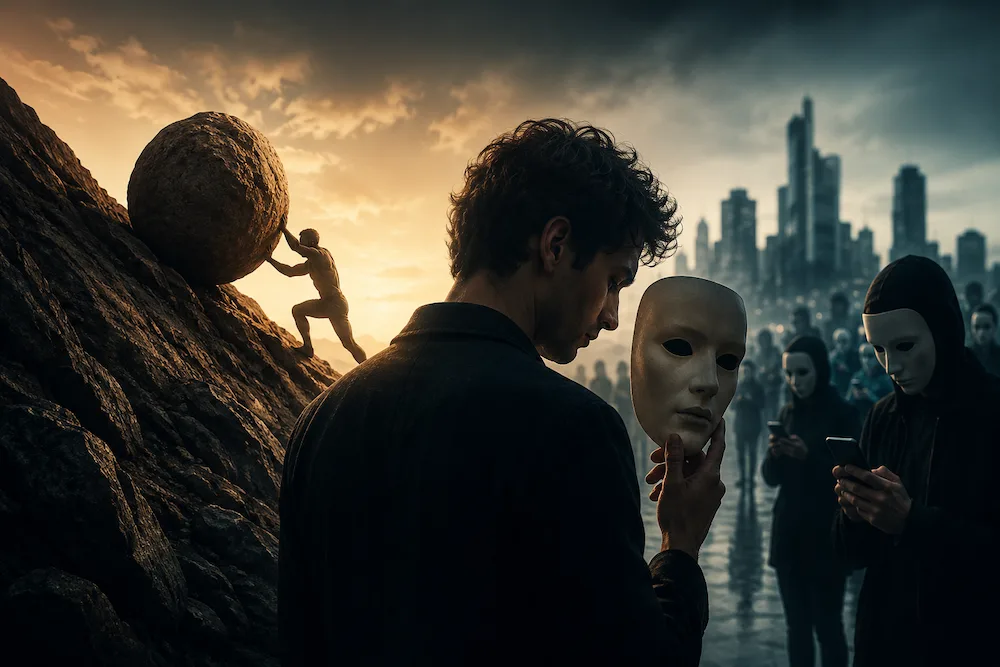
A man pushes a colossal rock up a mountain. His hands bleed. His body trembles. And just before reaching the summit, the rock slips, rolling back into the depths. The man must walk back down and begin again. This is Sisyphus: the timeless symbol of eternal, meaningless repetition. Yet in philosophy, Sisyphus is not a tragic figure. Instead, he holds the key to understanding what it means to be human in an absurd world that offers no answers.
Albert Camus used this myth to illustrate "the absurd"—the friction between the human desire for inherent meaning and the cold silence of the universe. Camus believed the absurd begins the moment we pause, look around, and ask why. When the world gives no answers, we are faced with three choices.
The first is physical suicide, chosen when a person can no longer bear this existential emptiness. Camus rejected this path, viewing it as a surrender to the absurd rather than a confrontation with it. In literature, we often see characters crushed by this unbearable void. A prime example is Sadegh Hedayat’s The Blind Owl, a dark psychological masterpiece steeped in isolation and despair. The novel maps the harrowing psychological landscape of what happens when a person can no longer find a reason to exist. The second choice is philosophical suicide: fleeing reality by seeking refuge in religion or ready-made ideologies.
The third choice is rebellion—accepting the ultimate meaninglessness of the world, yet choosing to live vibrantly anyway. This is where a constructive form of nihilism takes root. Long before Camus, Friedrich Nietzsche warned that humanity’s old sources of meaning were collapsing. His famous declaration that "God is dead" was not a celebration, but a warning. If our old certainties disappear, we must learn to forge our own purpose. If nothing has predetermined value, we are entirely free to find meaning in the immediate—in friendships, in art, or in a great cup of coffee. As Camus famously concluded, "One must imagine Sisyphus happy," because he owns his destiny every time he walks back down the mountain to claim his stone.
While Camus looks outward at our relationship with the universe, Søren Kierkegaard looks inward at the individual psychology of formatting our lives. Kierkegaard argued that most people simply go with the flow, conforming to societal trends and prioritizing middle-class comfort over radical, authentic change. To break out of this complacency, he mapped three stages of existential existence:
The Aesthetic: The aesthetician lives entirely for pleasure, novelty, and the thrill of the unique moment. They flee anything boring, banal, or mandatory. Yet, this lifestyle is built on quicksand, leaving the individual trapped in quiet anxiety and internal emptiness.
The Ethical: The moralist steps up to take genuine responsibility for their life. Rather than drifting or imitating the crowd, they commit to personal duties, relationships, and a defined path. To bridge this to Nietzsche’s thought: this radical self-authorship mirrors Nietzsche’s concept of the Übermensch (the Superman)—an individual who rises above the passive "herd," shatters outdated societal norms, and creates entirely new values to conquer nihilism.
The Religious: This final stage arrives when an individual realizes that pleasure, distraction, and reason alone cannot quiet the anxiety of existence. They reach for something eternal beyond the material world. For the religious individual, meaning is not constructed out of thin air; it is discovered through a personal relationship with the divine. Faith becomes a radical tool for enduring uncertainty, suffering, and the fear of the void.
Building on this legacy of absolute personal responsibility, Jean-Paul Sartre declared that human beings are "condemned to be free." Because no divine blueprint dictates our choices, we are forced to define ourselves every single second. This freedom is terrifying because the weight of responsibility falls squarely on our shoulders.
When we try to escape this weight—whether by throwing up our hands like the aesthetician and saying, "That's just who I am," or shifting blame like the dogmatist by claiming, "It was God's will"—we fall into what Sartre called bad faith(mauvaise foi). We deceive ourselves, pretending we are helpless victims of circumstance or higher powers rather than active authors of our lives. We see this constantly in literature and film: characters trapped in miserable roles they despise, simply because they lack the courage to break free.
Today, this search for meaning has migrated to a new arena: social media. To understand our digital lives, we can look to the sociologist Erving Goffman and his theory of dramaturgy. Goffman divided human interaction into two zones:
The Front Stage: The polished, curated performance we present to the outside world—our digital profile.
The Back Stage: The private space where we drop the mask and can truly be ourselves.
The modern crisis arises when our social frameworks pressure us to never leave the front stage. When you are trapped in a perpetual performance, you eventually forget who you are without an audience. Ultimately, whether we look at ancient Sisyphus or our own hyper-connected lives, the human condition remains unchanged. The world will not hand us a script or answers. We are the directors of our own theater. Centuries ago, Shakespeare famously wrote,
"All the world's a stage, and all the men and women merely players."
But perhaps the real question for us today is not whether we are actors. The question is whether we are playing a part we actually chose. Now that we are standing on the stage, we must decide: are we going to truly live, or merely perform?